
When Maria Montessori first brought bead chains and wooden numerals into her classroom, she wasn’t just decorating a shelf—she was opening a doorway to mathematical thinking that feels tangible, friendly, and empowering for young learners.
Today, her method still invites children to explore quantity, sequence, and pattern with their fingertips before tackling symbols on paper. The result is a math journey that sparks curiosity, builds true number sense, and steadily guides students toward confident abstraction.
Concrete Materials Lay the Foundation
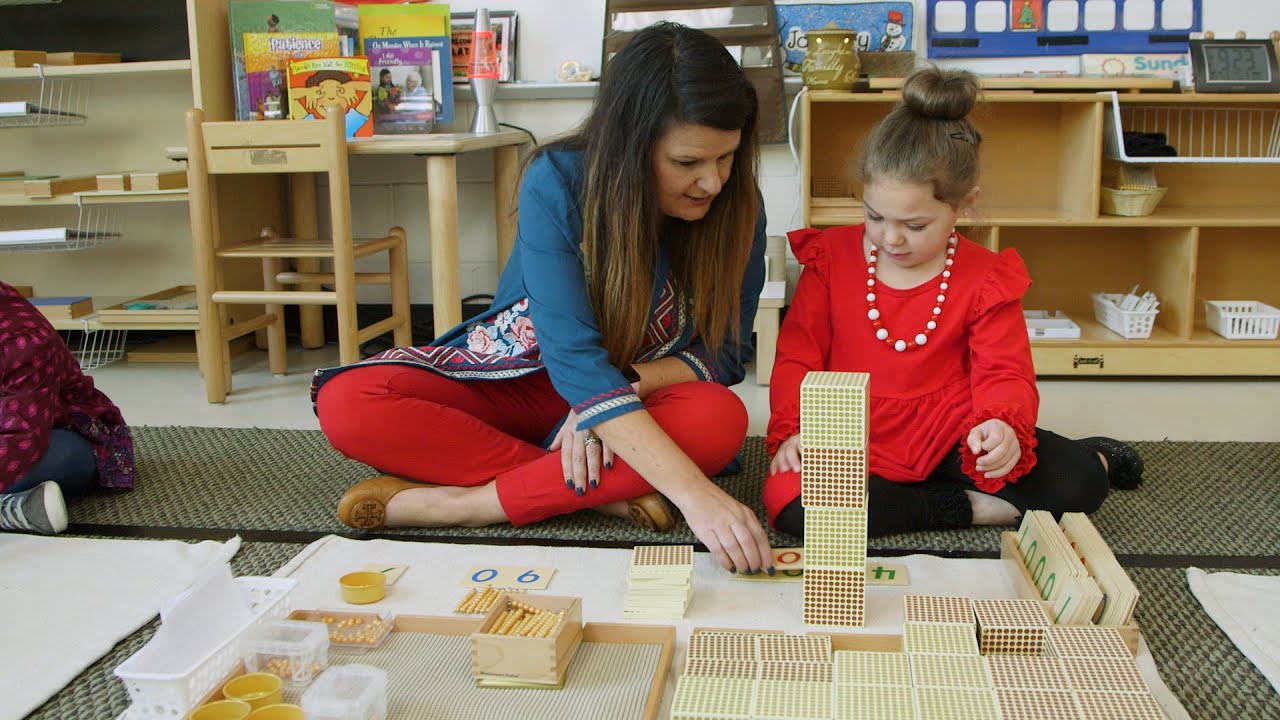
In every Montessori room, math begins on a low shelf stocked with golden beads, spindle boxes, and colored number rods. A child might start the morning by carrying a ten-bead bar to a mat and pairing it with a wooden tile that reads “10.” That simple act anchors the written symbol to a weighty, glimmering reality.
Over weeks, students stack bead bars into squares and cubes, physically experiencing that ten tens make a hundred and ten hundreds make a thousand. Because concepts live in their palms first, children internalize place value, regrouping, and skip-counting long before a worksheet ever appears.
Moving from Hands-On to Abstract
Once muscle memory and visual patterns are firmly in place, the guide introduces bridge materials—stamp games, dot boards, and small movable numerals—that lighten the sensory load while keeping the logic intact. Here, children practice addition, subtraction, and even long multiplication by sliding colored “stamps” across a felt board, gradually relying less on beads and more on mental tracking.
The final leap arrives with squared paper and pencil, where the same operations unfold symbolically. Because each layer mirrors the last, no step feels abrupt; the abstract merely becomes a lighter, quicker version of the concrete work they already love.
Multi-Age Peer Learning
Montessori classrooms group children across a three-year age span, and math time showcases the power of that design. A six-year-old arranging bead chains often attracts the curious gaze of a four-year-old, who soon asks to help count links. Meanwhile, an eight-year-old revisits fraction circles to coach a younger friend through halves and quarters, reinforcing her own mastery in the process.
These spontaneous mini-lessons build a culture where asking questions is normal and teaching others is a badge of pride. The room hums with quiet collaboration rather than competitive tension, nurturing both mathematical and social growth.
Freedom Within Structured Choice
Although the environment is meticulously prepared, students choose which math work to tackle and how long to pursue it. One child may spend days tracing number lines, while another dives into decimal fractions. This autonomy lets each learner linger where mastery requires, yet gentle record-keeping by the guide ensures no critical concept hides untouched.
Regular check-ins provide subtle guidance—“Have you tried the checkerboard for multiplication yet?”—keeping progress balanced without dampening enthusiasm. The blend of liberty and accountability cultivates intrinsic motivation, a priceless asset for future problem-solving.
Conclusion
In a Montessori setting, math isn’t a race to memorize facts; it’s a carefully staged adventure from concrete experience to elegant abstraction. Beads, boards, and peer mentors offer steady footholds, while freedom of choice fuels genuine engagement. By the time students meet traditional textbooks, numbers feel alive, flexible, and friendly—exactly as Dr. Montessori imagined over a century ago.